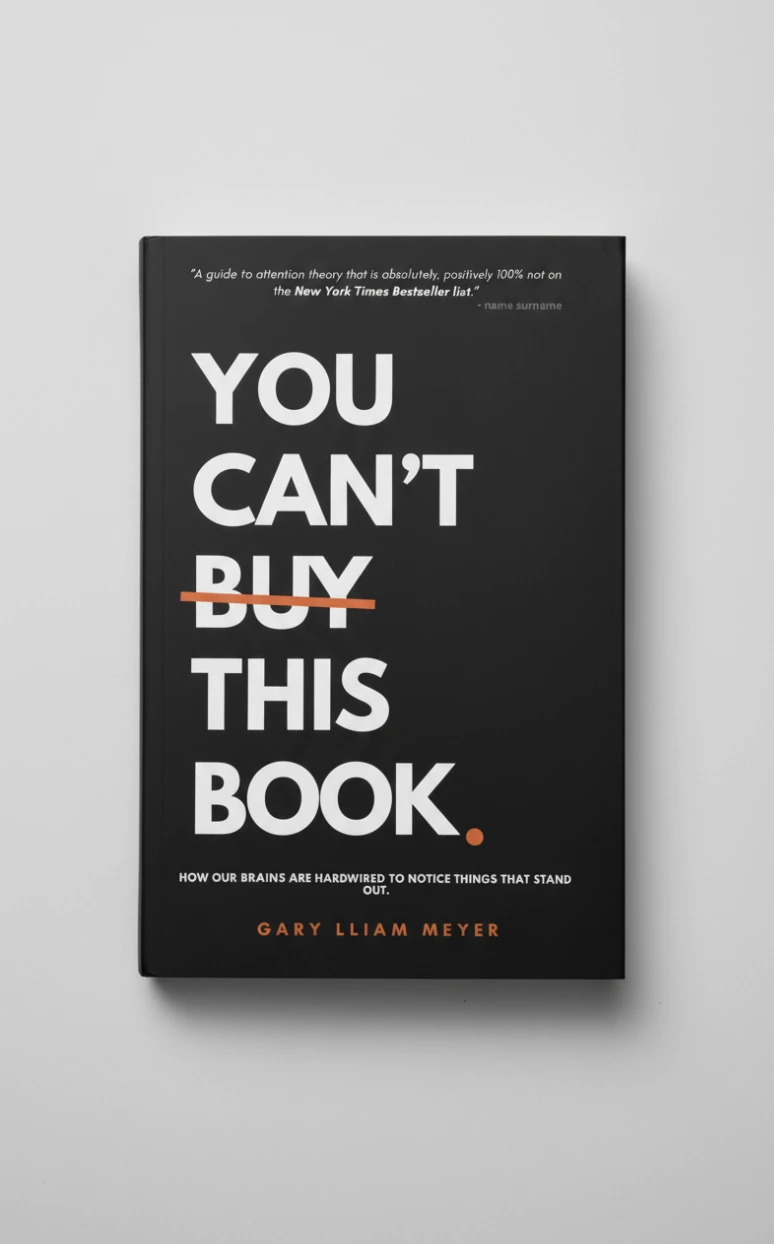
The only way to get a copy is to be given one by someone who thought you should read it.
That is not an accident. It is an experiment. A book about attention that tries, from the very first moment, to earn yours differently — not by buying its way onto your shelf, but by being placed there by someone whose opinion you trust.
Whether it worked is up to you.
What it is
You can’t buy this book is the trade-book companion to Attention Theory. It takes the framework on this site — the three gates, the five drivers, the reflex–decision spectrum — and tells it as a story. Twelve chapters, each one a piece of the architecture seen through a particular moment in the world: a Belgian doing the splits between two reversing trucks, a rainforest credited as an artist on a streaming platform, a colour on a bridge that has done its job for almost a century, a President elected on television.
The book’s ambition is not to be read once and shelved. It is to leave the reader with a working vocabulary — a quiet alarm that goes off when something deserves attention and isn’t getting it, or doesn’t deserve it and is getting too much.
Why it isn’t for sale
A book about attention that sells itself with the usual machinery — ads, affiliate links, retailer placement — would be quietly contradicting its own argument. The book argues that attention worth having is attention that is given, not bought; that the most reliable distribution mechanism in the world is one person handing something to another and saying read this; and that the publishing industry’s default assumption — that volume and visibility are the same thing — is precisely the misunderstanding the framework exists to correct.
So the book is given, not sold. It travels by recommendation. It either earns the right to keep travelling, or it stops, and either outcome is honest.
How to read it
If you are reading this on a public copy of the site, you have not yet been given the book. That is fine. The framework on this site is the same framework the book describes. Everything important is here.
If someone has given you a copy, you already know what to do.
How to give it
Copies are available, on request, for people who have a specific person in mind to give one to. This is not a waitlist. It is a small machine for putting the book in the hands of the readers most likely to find it useful, by way of the people who already know them.
To request a copy to give, write to gary@theoryofattention.com with the name of the person you want to give it to, a sentence or two about why, and where to send it.
— You can’t buy this book. Gary Meyer. 2025.